
Be an Airline Pilot for a Day
Review by Chris Mueller
Last Updated March 18, 2006

Chris Mueller (left) and John Schumacher (right) in UAL's B777 Simulator.
It all began a little over two years ago when I stumbled upon the United Airlines Services web site where I read an announcement about a program that would give the public an opportunity to fly a commercial jet simulator. Shortly after this announcement, UAL Services launched the "Be an Airline Pilot for a Day" program at which time I began saving my pennies for this once in a lifetime opportunity.
After two years of saving I finally had enough for not just any simulator package, but the Queen of the Fleet. The Boeing 777 Gold Package includes a full tour of the United Airlines Training Center (located in Denver, Colorado), one hour cockpit briefing/orientation, two hours in the simulator, and 30 minute debriefing.
Scheduling the visit with the simulator session was very straightforward. I began the scheduling process by sending an e-mail to UAL Services expressing interest . Within two days I received a response from UAL Services' Ms. Dawn Thompson (Flight Training Services Account Representative). She included the latest package prices, program, hotel, and who to contact information.
Most of the available simulator sessions were early in the morning or late in the evening. This is because the UAL pilots and other Airlines who contract UAL Services take priority (for obvious reasons). The toughest part of scheduling the session was coordinating with the instructors' schedules. Ms. Thompson was a great help throughout the scheduling process. Not only did she help schedule the session and coordinate with the instructors' schedule, she also assisted us by making our hotel arrangements. We would like to thank Dawn for her hard work and effort in making this dream come true for John Schumacher and I.
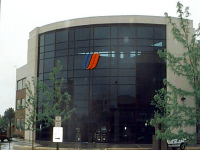 UAL's Training Center, Denver |
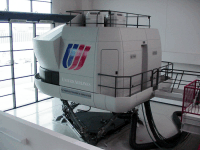 B777-200 Simulator Bay |
United Airlines began as a postal carrier in the 1920's and continues to maintain its position as the largest carrier of mail by transporting over one million pounds of mail per month. Varney Airlines, National Air Transport, Boeing Air Transport, and Pacific Air Transport were the companies that formed what is now the World's largest airline.
United employs approximately 10,000 pilots, 22,700 flight attendants, 27,000 mechanics, and 35,000 management/salaried. As a result, United averages 2,323 flights carrying 238,000 passengers per day.
United's fleet is comprised of the B727-200, B737-200/300/500, A319/320, B757-200, B767-200/300, DC-10-10/30, B777-200, B747-200/400.
Our host-instructor was United Airlines pilot/instructor Frank Smith. Frank has been with United Airlines since April of 1996. At 39 years old, Frank is currently a First Officer and instructor on the B777 with a bid for a B737 Captain in Denver.
Frank began his professional aviation career with the United States Marine Corps. While in the Marines he flew over 40 missions in the AV-8B Harrier during the Persian Gulf Conflict (Desert Shield/Desert Storm). After joining United, Frank flew as a Flight Engineer on the B727 for six months, a First Officer on the B757 for two years, and was recently promoted to the B777 in September 1999. With over 5,000 hours, he has been an instructor on the B777 since January 2000 and says it is the best airliner he has ever flown.
|
With the introductions out of the way, Frank took John and I on a tour of the Denver Training Center. The Training Center was completed in 1968 with the latest addition completed in 1990. United conducts all initial and recurrent training at the Denver Training Center. This helps to assure a high level of quality control over the pilot work force while being cost effective.
The Training Center houses 36 simulator bays and 36 simulators in the training facility. Since this is the only training facility for UAL's 10,000 pilots, it retains the title as the largest airline pilot training facility in the world.
UAL also trains approximately 7,000 of its Flight Attendants at the Denver Training Center each year. An average of 140 flight crews are trained every month. This breaks down to an average of 465 people daily at a cost of $1,400 per pilot per day. United also sells $10-13 million in Contract Training to over 100 other airlines worldwide.
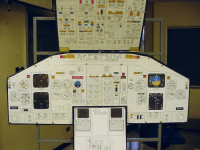 B737 panel layout training aid. |
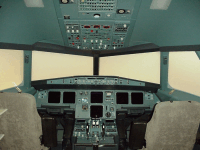 A320 procedure trainer. |
After our tour of the Training Center we headed to the simulator bays. Upon entering the simulator bays our level of excitement rose about 200%! Frank showed us the small briefing rooms (one for each simulator) which contains a TV/VCR for reviewing training videos, cockpit layout map, and several other training aids. Frank explained that training sessions begin in the briefing room where the flight crew and instructor review the upcoming training session. Frank then said with a big smile, "...you gentlemen ready? Lets go flying!"
We walked across the bridge to the giant B777 simulator (pictured at the top of the page) and peered into the open door with huge smiles on our faces like children visiting Disneyland for the very first time. Frank asked who was going to be the Captain. John and I looked at each other with a smile. John then told me to go ahead and take a seat on the left side (thank you Schu!). After a brief cockpit orientation which included how to properly set your seating position, panel familiarization, and systems check we were ready to go.
Looking out the front windscreen we saw that we were parked at UAL's San Francisco International terminal. As Frank activated the motion system we felt a slight sinking sensation at which time he explained the pushback procedure. After starting the APU and with the parking brake released, we began pushback. During the pushback we could feel the slight bouncing and sideways motion as the aircraft backed and turned to the right. With the pushback complete I set the parking brake and Frank began reviewing the engine start procedure.
Starting the giant GE engines using the autostart system in the B777 is a very easy process. Frank advised that the First Officer usually starts the engines on United's B777's. John rotated the START/IGNITION selector to "Start" and moved the FUEL CONTROL switch to the "Run" position. The Electronic Engine Controller (ECC) controls the ignition and fuel and automatically aborts the start sequence if a malfunction occurs. With the START/IGNITION selector in the "Start" position the ECC uses the APU's bleed air to power the starter motor which is connected to the N2 rotor in the engine. The FUEL CONTROL switch in the "Run" position opens the spat fuel valve, but does not open the engine fuel valve. At the appropriate N2 rpm the ECC opens the engine fuel valve and the ignitor(s) energize. The ECC then shuts down the starter motor and the START/IGNITION selector rotates to the "Norm" position. As the engine spools up to idle rpm the ECC monitors the EGT, N2, and other engine parameters. The ECC will abort the start sequence if there is no N1 rotation, hot or hung start, no EGT rise, compressor stall, insufficient air pressure from the starter assisted start, or the start time exceeds the starter duty cycle timer.
With both engines running and stabilized we were ready to taxi to runway 28-Left for our departure. Frank instructed John to set the flaps to 5°, so John reached down and moved the flap lever to the 3rd notch. Frank explained that the airplane's response to throttle movement may be slow because we were at a high gross weight, but one we start moving idle thrust should be enough to maintain our taxi speed. I released the brakes and advanced the throttles to 30% N1. The B777 lurched forward and started to accelerate slowly as we approached the taxiway. I returned the throttles to the idle position as we approached our first turn onto taxiway Bravo. As we taxied around, the simulator bounced and swayed adding to the realism. John and I learned how to properly line up for a turn, taxi straight, and slow to a stop. As we taxied Frank began setting up the FMS and autopilot for our departure on the Offshore Four SID.
To save some time, Frank repositioned the airplane on the threshold of runway 28-Left for takeoff. After configuring the autopilot, trim settings, and completing the takeoff checklist it was time to go flying! I advanced the throttles forward to 40% N1 and monitored for positive reaction from the engines. Once the engines began spooling up I pressed the TO/GA switched located under the throttle's top grip and the throttles automatically advanced to a reduced takeoff power setting. As John called "80 knots" I crosschecked the airspeed indicator and thrust settings. John then called "V1... Vr" and I rotated the nose at 3° per second to establish a pitch attitude of 15°. As our rate of climb passed 1000 feet per minute John called "positive rate" to which I responded "gear up." John reached forward and raised the landing gear.
As we climbed from the runway, we were flying the aircraft manually, so all I had to do was keep the flight director bars centered in the artificial horizon. The VNAV autopilot mode commands the flight director to indicate the proper pitch to maintain V2+15kts. As we passed 800 feet AGL we lowered the nose to accelerate to 230kts while retracting the flaps on schedule. Once we passed 3000 feet MSL we accelerated to 250kts which we maintained until crossing 10,000 feet MSL. Meanwhile the LNAV autopilot mode commands the flight director to indicate the proper rate of turn to maintain our course on the SID. As we passed 5,000 feet Frank had us engage the autopilot. With the FMS and autopilot in command Frank began showing us the various systems and settings for the primary, secondary, and ECIAS screens.
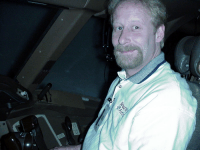 John Schumacher |
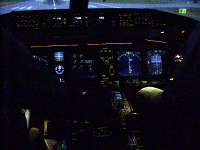
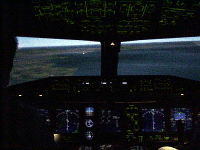
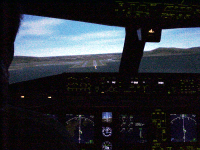 John's non-precision approach to KSFO Rwy 28R. |
Once we leveled off at 14,000 feet Frank had us disengage the autopilot and John took the controls. Frank instructed John to use full left aileron and roll the airplane. To our surprise the giant B777 rolled upside down effortlessly. As John exited the barrel-roll the stick shaker went off and we entered our first stall. Frank then instructed John on a textbook recovery by pushing the nose down and applying full power until the aircraft builds sufficient speed to climb. We asked Frank if the Boeing team ever did a barrel-roll with the real aircraft. Frank chuckled and said that he was not sure and he would not recommend trying it in real life.
After our brief aerobatics lesson, we moved into slow flight and stalls. The B777 was surprisingly agile at slow speeds and did not exhibit the lethargic control response that one would expect from such a large and heavy aircraft. Frank reduced our power to idle and had John apply back-pressure to the yoke until the stick-shaker activated. The stick-shaker is a warning device that signals to the flight crew that the aircraft is approaching stall (stall speed and/or angle of attack). Frank told John ignore the stick-shaker and aircraft buffeting, and continue to apply back-pressure to the yoke until the yoke was pulled all the way back. The B777 then entered a full stall setting off a symphony of visual and aural warnings. John once again executed a textbook stall recovery.
After John and I switched seats it was time for a challenge. Frank lined up the airplane on a 10 mile final for KSFO's runway 28-right for John's first non-precision approach and landing. With the flight director set to track the ILS John flew the entire approach by hand. As Frank gave us updated speed settings I would dial them into the autopilot and set the flaps. At 1,000 feet AGL I set the flaps to 30° for landing and crosschecked the final approach speed setting. At 30 feet AGL the autopilot reduced the power to idle as John raised the nose to flare the airplane. We touched down just past the touchdown markers, applied reverse thrust, and taxied off the runway.
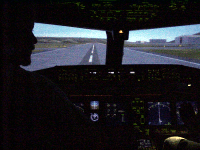
John and I switched seats again and it was now my turn to try the non-precision approach, but to make it different I flew mine at night. Just like John's approach I followed the Flight Director as it tracked the ILS to about 500 feet AGL. As we passed 500 feet I used the VASI as my reference for the rest of the approach. My landing concluded just as John's did with no problems.
Since we were practicing landings, Frank wanted to demonstrate the CAT-III Autoland feature of the B777. Frank set up the airplane on a 10 mile final with 1/8 mile visibility (fog), stiff crosswind, and thunderstorms with heavy rain. As the autopilot flew the approach all we had to do was dial in the speed settings, lower the flaps, and lower the landing gear. Despite the turbulence and crosswind the autopilot held the airplane's position on the ILS. The autopilot flared the airplane, reduced the power to idle, and even held the airplane on the runway centerline during the roll-out until the autobrakes brought us to a complete stop. All I had to do was apply the reverse thrust. Once we came to a stop, Frank changed the time and weather settings to show us our position. We were perfectly lined up on the centerline with about 1,500 feet of runway left. Truly amazing!
Next it was time to work up a sweat with some emergencies. Our first emergency was an engine failure during takeoff. Frank explained to us that the B777 has a special system that maintains symmetrical yaw coordination while the aircraft is in flight. Thus, if an engine fails this system will instantly recognize the failure and apply the appropriate amount of rudder into the operational engine.
We accelerated down the runway to V1, then John called "Vr" and I rotated the nose. As the aircraft left the ground, Frank failed the right engine. As the Master Warning came on and the engine spooled down, the right rudder pedal slid forward automatically to compensate for the amount of yaw caused by the remaining engine. The autopilot automatically increased our power setting on the remaining engine from reduced takeoff power to maximum continuous power. I then maintained our position on the extended runway centerline while lowering the nose slightly to accelerate to V2 + 15. Once we reached the engine out flap acceleration height, the flight director commanded a near level climb to allow for acceleration and flap retraction. Once the flaps were up the FMC commanded a climb at our flaps-up maneuvering speed. I have to admit that the auto- symmetry system made the aircraft easy to handle despite the fact that there is nearly 90,000 pounds of thrust pushing from the remaining engine.
Now it was John's turn and to make it interesting, he wanted the auto- symmetry system turned off. As John passed Vr and rotated the aircraft into the air, Frank failed the right engine. The instant yaw to the right was so great that John only had a few seconds to react. The airplane quickly rolled to the right and pitched down. Our right wingtip struck the ground which caused the nose to violently pitch forward and strike the ground. "WOW!" was the reaction from John. It was amazing to experience the actual amount of power put out by one engine and what effect it really has on the aircraft if not controlled immediately.
John smiled and asked to try it again as he was not about to let the aircraft beat him. On his second attempt without the auto- symmetry system John performed much better. Frank failed the left engine as we lifted off the runway. As I called "engine failure, (engine) number one..." John applied full right rudder, regained control of the aircraft, and continued our climb. Frank then helped us by applying right rudder trim to maintain our directional control.
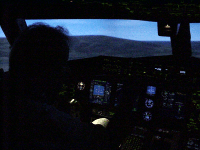 John manually climbs out on one engine. |
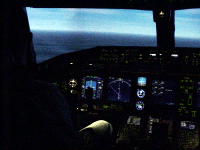
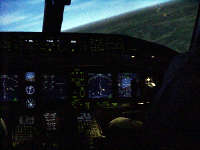 Chris banks hard right for a TCAS-Alert. |
The next emergency we chose was TCAS (Traffic Collision Avoidance System) avoidance. Frank set us up at 5,000 feet with multiple aircraft in the area. As we maintained our heading the TCAS voice alert sounded "TRAFFIC TRAFFIC" and the amber message "TRAFFIC" was displayed on the Navigation Display. As we continued on the same heading the TCAS voice alert gave vertical guidance commands "DESCEND... DESCEND NOW... INCREASE DESCENT" while a red box was displayed over the top portion of the Attitude Indicator which indicated where not to steer the aircraft. As we cleared the traffic the TCAS then gave of the advisory that we were clear of the conflicting traffic and we returned to our original altitude and heading.
With only 10 minutes left we chose to try the most frightening environmental emergency, windshear. Windshear is any rapid change in wind direction or velocity and is responsible for many major accidents and crashes. John was set up to fly a CAT-I approach into KSFO's runway 28-left. As John flew the approach and descended through 1,200 feet AGL our airspeed suddenly dropped 20 knots the simulator's motion system lurched forward. An aural warning, "WINDSHEAR WINDSHEAR WINDSHEAR", was heard as Frank began instructing us on our escape and recovery. Frank instructed John to reach forward and press the TO/GA buttons on the throttle twice to give us maximum continuous power. The Flight Director command bars commanded a 10° nose-up attitude as John increased our rate of climb. As we climbed we once again passed through the windshear accompanied by the aural warning. Frank explained that as you escape and climb out from a windshear the aircraft's configuration is left alone until a safe altitude is reached. Thus, as we climbed out with the gear down and 30° of flap to about 3,000 feet at which time we began to "clean up" the aircraft by raising the gear and retracting the flaps on schedule.
Before we knew it our 2 hours of glory were over. As we exited the simulator Frank expressed how he was impressed by our ability to fly the giant B777 and told us that it takes a certain talent to understand and perform the various duties as we did. Of course, John and I were flattered by this compliment. John dropped the bomb on Frank by telling him that aside from his PC-based flight simulator, he has never flown a real airplane. Frank was very surprised and awed by this. Frank agreed that the PC-based flight simulators are a good training tool.
Dawn Thompson and Frank Smith made this a very exciting and memorable experience. Thanks to their professionalism and enthusiasm this was an experience that John and I would not give up for anything. I highly recommend it to anyone who is interested. Some people may be intimidated by the prices of the various programs. I know I was at first, but I set the goal and saved for two years. I have even started saving again and hope to return to the UAL Training Center to fly the B757 or B747 within the next few years.
WHO TO CONTACT:
Denver Training Center Flight Training Services: 303-780-3600
John Schumacher is WestWind Airlines KSFO Hub Manager and is also recognized by the Flightsim Community as a panel and flight dynamics designer. Chris Mueller is WestWind Airlines Vice President of Aircraft and Scenery and a former aircraft reviewer for AvSim-Online.
 Back to WestWind Airlines Home Page